Understanding the basics of Remittances: World Of Payments IPR Training – Key Takeaways
Last month, we successfully launched our first IPR training session, led by our esteemed payments expert, Ibrahim Muhammed. With a remarkable track record of over 20 years in the industry, Ibrahim brought unparalleled expertise and insights to the program.
Designed specifically to enhance participants’ knowledge and skillset in the money transfer industry, our series of trainings aim to educate and propel individuals forward in their professional journey.
Our first training kicked off with World of Payments, an introduction to the fundamentals of the key concepts and dynamics of the remittance industry. If you couldn’t attend the live sessions, don’t worry as you can still sign up at a reduced rate and access the on-demand session.
It’s a great opportunity to enhance your expertise, earn CPD points, and secure a certification. You can register online here: https://payments2023.ipr-events.com/register
Now let’s dive right in and explore some of the key takeaways from the 2-day online sessions.
- The Surging Importance of Remittances for Economic Growth
The impact of remittances on economic growth in developing nations cannot be understated. In 2022, countries received transfers worth over $700 billion from diasporas working abroad. These funds serve as a critical source of income for families, bolstering their purchasing power, healthcare access, and educational opportunities.
Interestingly, remittances have surpassed other categories, including foreign direct investments, in their contribution to economic growth. This substantial inflow has prompted global jurisdictions to impose stricter sanctions, emphasizing the need for formal remittance channels that promote transparency and traceability of funds.
- Understanding the Remittance Ecosystem Players
A crucial aspect of achieving success in the payments industry is understanding the diverse roles of participants within the remittance ecosystem. From financial institutions to technology providers, regulators to consumers, each stakeholder plays a vital role in facilitating the seamless transfer of funds across borders. By comprehending the complexities of this ecosystem, MSBs can identify potential partnerships and collaborations that align with their business goals, fostering growth and expansion.
- Forming Effective Partnerships with Aligned Goals
Collaborating with the right organisations can unlock new opportunities, expand your customer base, and enhance service offerings. By joining forces with compatible organisations, you can benefit from each other’s strengths and drive mutual growth. Actively building and nurturing these partnerships can help enable long-term success.
- Rise of Prepaid Cards and Wallets
Ibrahim shed light on the growing prominence of prepaid cards and digital wallets as convenient and sustainable payment options. With their ease of use, accessibility, and flexibility, these solutions offer a viable alternative to traditional banking systems. MSBs can leverage prepaid cards and wallets to tap into new customer segments, enhance financial inclusion, and provide seamless cross-border transactions.
IPR Training Sessions – Offering CPD Points and Certification
We have more exciting upcoming events you can sign up for. Discover the full schedule of events and reserve your spot now at: https://www.ipr-events.com/.
Remember, tickets are limited and allocated on a first-come, first-served basis. To ensure your participation please secure your seats early.
Don’t miss out on these exclusive opportunities to expand your knowledge, connect with industry experts, and stay at the forefront of cutting-edge developments.
We look forward to seeing you in our IPR training sessions!
RemitONE Winners of the Remtech Innovation Remittance Solution Award at GFRID | United Nations Summit in Kenya, Africa!
We are delighted to announce that RemitONE has secured the prestigious Innovation Remittance Solution Award at the RemTECH Awards 2023 – GFRID | United Nations Summit in Kenya. This incredible achievement underscores our commitment to revolutionising the payments and remittance industry through cutting-edge solutions.
The RemTECH Awards, organised by CrossTech and held as part of the GFRID | United Nations Summit in Kenya, served as a platform to honour remarkable achievements and advancements in the fintech industry. Over three days, industry professionals from around the globe congregated to celebrate and engage in an enlightening conference.
Our success in the Innovation Remittance Solution category can be attributed to the groundbreaking tools we have developed. Notably, our Multi-Online Remittance Manager™ and Multi-Mobile Remittance Manager™ have played a pivotal role in advancing financial inclusion. These game-changing solutions bridge the gap between the banked and unbanked populations, providing greater accessibility and convenience for money transfers through our digital innovations.
We had the privilege of being assessed by esteemed judges who acknowledged the significance of our innovation. Leon Isaacs, judge and CEO of DMA Global, presented us with the award and praised our approach. He emphasised, “RemitONE has seen a problem and looked at various solutions and put them together in a way that truly works for the people who use their services or could utilise their services, which I think is innovative in many ways.”
Representing RemitONE at the event, our Managing Director of Africa, Ababacar Seck, accepted the award and delivered an inspiring acceptance speech. He reiterated our commitment to empowering clients, including banks, money transfer operators (MTOs), startups, and central banks, with innovative solutions tailored to their specific needs.
This award serves as a testament to our relentless pursuit of innovation and excellence. At RemitONE, we remain dedicated to shaping the future of the payments and remittance industry and improving the lives of migrants and their families worldwide.
To learn more about our award-winning Money Transfer Software reach out to us at sales@remitone.com.
How to Start a Money Transfer Business: Collaboration and Key Partnerships
Authored by Ibrahim Muhammad, Senior Consultant at RemitONE
Ibrahim Muhammad is a highly passionate payments professional with over 20 years of experience in Money Transfers and provides specialized consultancy to start-ups and incumbents.

So far we have covered various topics as part of our ‘How to Start a Money Transfer Business series’, including information on the basics of getting started with a Money Service Business (MSB), followed by the licensing options available to new MSBs with a particular focus on the UK. We have also covered a critical area of managing AML and Compliance for MSBs. In this article, we are covering yet another important topic: creating and maintaining collaborations with key stakeholders and partners in order to establish and grow your MSB.
What Partnerships Will I Need?
Establishing and maintaining the correct type of partnership is at the core of any MSB, particularly those offering cross-border remittances. There are several types of partnerships that an MSB needs to consider, as specified below:
Banks
Depending on the business model, MSBs might need to maintain bank accounts both domestically and internationally to facilitate the secure collection of funds from their customers and enable the transfer of funds. For international transfer of funds, MSBs can establish relationships with banks in the receiving countries for the remitters to send funds to their beneficiaries, primarily in the form of credit to bank accounts.
Today, the majority of banks offer APIs wherein the MSBs can directly and securely facilitate the instant transfer of funds to the relevant beneficiary accounts. Banks play a significant role in the fund flow and are the heart of the entire payment ecosystem. MSBs can opt to establish a relationship with a single bank in each of the receiving countries in order to facilitate the transfer of funds either to the same bank account or any other third-party bank account within the same jurisdiction. MSBs need to maintain sufficient funds upfront with each of the banks they establish relationships with to ensure the timely processing of funds to the beneficiaries’ accounts.
Money Transfer Network Operators
For new MSBs, it might be quite challenging to establish a bank account easily, mainly due to de-risking factors as well as liquidity constraints. Therefore, a quicker route is to collaborate with an established Money Transfer Network Operator that can facilitate cross-border payments to a wider network.
The advantage MSBs can have by establishing relationships with such operators is that they will have a single hub to facilitate pay-outs to different countries. This solution also empowers their remitters to send funds instantly and securely to their beneficiaries in the form of credit to bank accounts, cash collection or even mobile wallets in the receiving countries (subject to business and regulatory arrangements in place).
Payment Networks
MSBs that accept payments via cards or bank transfers from their customers (remitters) need to also maintain relationships with payment gateways and payment acquirers. As the trend is moving more towards cashless payments, it is important that MSBs maintain this type of relationship with payment networks. The majority of payment gateway providers and acquirers offer several types of pay-in channels for the remitters of the MSBs, such as VISA, Mastercard, and Paypal, and even facilitate direct bank transfers on the sending side.
Mobile Money Network Operators
Mobile network operators can help MSBs to reach customers in remote or rural areas who may not have access to traditional banking services. MSBs can partner with relevant operators to offer mobile money services. Several players in Africa such as M-PESA in Kenya have been pioneers in offering these mobile money services.
Retail Networks
Retail shops and other types of outlets are also important partners in the remittance ecosystem. They usually collaborate with money transfer operators, mobile money network operators or banks to become cash-in our cash-out channels. MSBs can also consider establishing relationships with retail networks that have extensive physical brick-and-mortar branch presence in the receiving countries.
Key questions to consider
MSBs need to ensure that they consider a range of factors before partnering with any of the aforementioned entities. Below are some of the key questions that an MSB needs to consider for it to decide on the right partnership:
- Does the partner fit into the business goals and model of the MSB?
- Are they regulated/registered in the relevant markets?
- Are they trustworthy, reputed, and transparent in pricing?
- Do they offer competitive rates and commissions?
- Will the partnership bring in more revenue, and increase the customer base of the MSB?
Overall, partnerships are a critical component for the growth and success of the MSBs. By partnering with the right entities, MSBs can expand their global reach, and improve their product types and services offered while also meeting the needs of their customers in various jurisdictions.
What next?
Thank you for taking the time to engage with our ‘How to Start a Money Transfer Business’ series – we hope you have found the content insightful!
If you’re looking to launch a Money Service Business or grow your existing business, RemitONE offers a comprehensive solution with our RemitONE Launchpad service. This bespoke service is designed to guide you through regulatory hurdles, support you with compliance requirements, and much more.
Our expert team will provide you with tailored advice on your unique requirements and objectives. We’re dedicated to helping you land, expand and flourish, and have a proven track record of successfully supporting all our clients at every stage of the process.
So, if you’re looking for a reliable and experienced partner to provide end-to-end support, please don’t hesitate to get in touch with us.
Tap into our experts and schedule a free consultation to get started.
Video: Saving the Crucial Role of Agents and Banks in the Remittance Industry
Brought to you by RemitONE, the Innovation in Payments and Remittances (IPR) Global Hybrid event took place on 19-20 October 2022 and included a series of fantastic discussions.
Wallets have been on the rise in recent years which has forced banks to embrace technological advancements to keep up with the pace of digital innovations in the remittance industry. In this panel, we uncover the driving forces behind this change and the possible impact it may have on banks, agents, and the overall money transfer landscape in the coming years.
Moderator:
- Ababacar Seck, Managing Director – Africa, RemitONE
Our panellists include:
- Sharon Gibson, CEO, JMMB Money Transfer
- Leon Isaacs, Founder and CEO, DMA Global
- George Boateng, COO, Unity Link
Why are pay-out transactions shifting to wallets?
There’s been an increase in the popularity of pay-out transactions through wallets, due to their accessibility and simplicity. This upward trend is particularly prominent in Asia and Africa. For example, in Ghana, the mobile money market reached $121.8 Billion in 2022 and is expected to grow to $590.7 Billion by 2028. George believes the reason behind this is attributed to factors such as convenience, as wallets are more easily within reach than banks, and overall save time and effort.
Leon also reinforces, wallets are often preferable as they’re easy to use which means people don’t require additional assistance. Other drivers are, the senders have more options, people have become more digitally savvy and most notably, it’s cheaper. Another key benefit of wallets is their increased security due to tokenization, which is a unique identification number attached to any personal information such as account numbers.
However, it’s not the same in every region. Sharon shares that in Jamaica there’s only one institute that offers mobile wallets, but that could change very soon. The recent launch of CBDC can possibly encourage more institutions to embrace digital wallets.
How can banks and traditional agents cope in the digital era?
Leon states in many cases it’s rare for agents or banks to be solely a remittance business. While they may have their core purpose, they should adapt and diversify their services to progress ahead in the competitive market. Sharon suggests that banks can collaborate with more agents to offer their products and services and satisfy client needs, however, there need to be adequate technology capabilities in place for it to be a success.
Data shows that customers prefer the physical contact of agents as they instil trust and provide clear guidance when a problem occurs, as opposed to communicating with a bot. A study even found that 64% of customers commented that they could not solve a problem when using mobile apps to transfer money. Overall, agents play a crucial role in building customer trust and loyalty especially as a large proportion of transactions are still carried out in stores and not through digital means, which proves they still hold a strong position.
There are different considerations for the send and receiving end for agents. The pandemic did accelerate a surge in people adopting digital payments and transactions which resulted in a lesser need for people to visit agents, and it’s likely that this will continue. As for the pay-out side, there is potential for agents to educate customers as online accessibility varies in countries where people are still hesitant about online banking and money transfers – this creates a good chance for agents to bridge the gap by acting as the intermediaries between clients and digital payments. Customers already trust these agents, which makes it more probable for them to adopt changes with the agents’ help.
Leveraging technology is another technique agents can utilise to enhance efficiency and strengthen their role further. For instance, many people have formed personal relationships with agents but sometimes lack financial literacy. In such cases, agents can take advantage of innovations such as card readers to increase customer security and reinforce the trust clients have in them. This can solidify the bond between the agent and client as well.
MNOs are taking over transactions led by banks, is this healthy? What does this mean for the future of final inclusion?
There is no denying that competition drives innovation and MNOs gaining the lead has pressured banks to also step up their game to progress ahead. MNOs often educate the underbanked on how to use their products, an area where banks are lacking. There’s also greater flexibility with MNOs, as people can instantly access their digital funds from the comfort of their homes without the need for documentation and physical visits to the bank, helping them to save precious time.
MNOs particularly boast a good distribution of agents across both send and pay-out. However, their products excel in locations where there is a vast digital presence (although they still have a huge potential to increase penetration of financial services, which will continue to encourage financial inclusion). In locations where there is good digital infrastructure, the need for agents to pay out cash is also lessened, this creates a window of opportunity for them to diversify their products and services. One example is M-pesa in Africa, where digital wallets are the primary method of payment. As a result, customers rarely use physical cash, which suggests that people will only need to visit a branch for a specific need unrelated to money transfers or cash-outs.
The changing face of remittance clients requires a new approach, how can MTOs keep on top of the needs of clients and how will this affect the business model?
In contrast to the past, migrants are more skilled individuals and therefore less reliant on agents, demonstrating increased digital literacy. As a result, the power balance has shifted to the customers, with the internet providing easy access for them to quickly switch to other companies if they are unsatisfied with the service.
Clients also tend to focus more on convenience, such as banking being available everywhere at any time and more demand for receiving immediate results. This places a heavy burden on banks – they often have to increase their costs to expand their workforce and enhance their operations more robustly. However, with the increasing popularity of social media, email, live chat and phone, it becomes challenging for the banks to meet the demand – this can lead to dissatisfaction, complaints and negative reviews, overall damaging the brand’s reputation.
To minimise this problem, Sharon proposes a collaborative relationship between banks and agents, to exchange knowledge and expertise and gain a thorough understanding of the client’s needs. Leon explains that companies need to rethink their strategies to maintain a close connection with clients whilst keeping pace with their changing needs. However, a positive takeaway is that customers are benefiting from having their needs finally met and the industry continues to thrive.
Can technology help agents preserve their role?
Whilst technology can be costly, it can be a useful tool to streamline operations more effectively. One way is gathering accurate data in a more interactive way instead of relying on traditional surveys. Social media platforms like Twitter polls can help analyse consumer behaviour, identifying factors which motivate them to pick specific agents over others.
As the rapid surge of digitalisation continues, more businesses are having to adapt. At RemitONE, we play a pivotal role in helping banks shift to the online realm. Our software empowers agents to provide customers with user-friendly portals whilst providing an array of options for them to choose from, such as airtime top-ups, prepaid card services and more. By utilising our industry-leading software, you can increase your transaction rates whilst maintaining top-notch security through our AML and KYC checks. This results in a seamless process from send to pay-out. You can also gain access to our global network of clients and partners that we have built over decades for you to access right away, saving you time, cost and headache.
Interested in powering up your business? Get in touch with our experts to provide your customers with a secure, convenient, and exceptional money-transfer experience.
Tap into our experts and schedule a free consultation.
References
https://www.imarcgroup.com/ghana-mobile-money-market
https://www.westernunion.com/blog/en/leery-of-how-digital-wallets-work-let-us-break-it-down-for-you/
Video: Cryptocurrency as a Payment Method – The new growth potential for money service businesses
In our latest IPR Webinar, our expert partners from BP Ventures LLC joined RemitONE to explore the use of Cryptocurrency as a payment method in the money transfer industry, and how using the USDC can benefit money service businesses as they shift to a more digital way of transacting.
Webinar moderator:
- Aamer Abedi, CMO, RemitONE
Panellists:
- Jeffrey Phaneuf, Director, BP Ventures LLC
- Anthony Barker, Director, BP Ventures LLC
- Arif Saleem, CTO, RemitONE
Time Stamps
00:00 Introductions
14:24 What is the next big thing in the ecosystem for remittances?
17:29 How have you seen payment methods change over the years?
19:37 What is USDC? How does it compare to other USD-denominated stable coins?
23:29 Why use the USDC stable coin as a payment mechanism?
28:27 What is the fear that MTOs may have using USDC? How do we address this?
31:31 How can we address the bank account issue?
34:45 What are the benefits of using USDC as a payment mechanism for the individual users?
37:54 What’s different from paying with a stable coin instead of traditional methods?
40:19 What is the cost to the MTOs?
43:10 How do we take advantage of the Moneygram USDC opportunity?
44:03 Risk profile of USDC vs. cash or card?
44:56 How can USDC as a payment mechanism decrease Chargeback rates & Fraud?
45:47 Margins are compressing for MSB’s, how does using USDC help increase revenues?
47:14 Are users going to use stable coins & can we settle it?
53:05 Next steps, how can we implement USDC as a payment mechanism leveraging RemitONE?
59:48 What procedures and policies need to be in place to enable USDC?
Please let us define the terms blockchain cryptocurrency stable coin and token.
Anthony: So, Blockchain is a word that you’ve probably heard in the news everywhere. It comes from Bitcoin which has a technological system where that verifies blocks of transactions (the blocks come every 10 minutes) and computers all over the world. Right now, in Bitcoin, there are over 5000 computers, called validators, that validate the transactions.
An example of a cryptocurrency is Bitcoin. Cryptocurrencies typically use blockchains. So, the ones you might have heard of might be Ripple, Stellar, Bitcoin and Ethereum. The difference between a stable coin and a token is that a stable coin is typically tied to the value of a currency. So, the one we’re talking about today is called USDC.
USDC is a stable coin issued by Circle Corporation, which is a US-regulated financial institution. It’s audited by third-party auditors. So, these are stable coins, they’re tied one to one. And in theory, you should be able to cash out $1 of USC for one US dollar.
Why Stellar? What, in your opinion, distinguishes Stellar from other blockchains?
Anthony: Stellar and Ripple would have been built up, really to focus on the international cross-border payments. At that point, Ripple was closed source; it was owned by one corporation and was really focused on promoting its XRP token, which was issued mostly to employees, founders and investors in Ripple. Then I compared it to stellar, all of the software was open-source from the beginning, and that seemed to me to be a better platform to build on where you can add additional value.
The volatility in the cryptocurrency markets, as evidenced by the fluctuating Bitcoin value graphs, can make a money service business, which obviously wants prices to be as stable as possible, extremely nervous. How does cryptocurrency as a payment method solution, that BP Ventures and RemitONE are proposing here, address this concern of volatility?
Anthony: Bitcoin and Ethereum are mostly used on these offshore contract-for-difference trading platforms, which are highly leveraged. So people are individual traders are trading at it at a 10 to one ratio or a 100 to one ratio, so you can have 100 bitcoins controlled with your one Bitcoin. So when the market collapses it has a tendency of going up very quickly and down very quickly now. But stable coins, because they’re tied to the US dollar or Euros, they are much better for remittance companies.
If you look at the bailouts that occurred in 2008, when major companies like Barclays and other major institutions went bankrupt, they had to have government intervention to save the whole ecosystem. If you look at cryptocurrency, to give them some benefit of the doubt, it’s still running. There are still transactions clearing, there’s still settlement, and the USSC dollar is still worth $1. So it is growing, and its funds are based on US Treasuries. So they’re not sitting their money in some risky offshore thing. All of their funds are in short-termed US Treasuries. So USDC is safe. With other Cryptos, there are different levels of risk.
What is the next big thing in the ecosystem for remittances?
Jeffrey: I think given the recent announcement of Moneygram’s cooperation with Stellar to offer USDC the cash in cash out, we believe that digital crypto blockchain powered payments is potentially the next big thing in the ecosystem. We’ve been involved in Stellar blockchain for a number of years. I think the fact that MoneyGram has confirmed their entry into this space, certainly confirms that using USDC as a payment mechanism on Stellar blockchain has some merits.
Arif: One of the big problems in remittances is the friction at different levels when you’re talking about international transfers. And any new technology, that can reduce that friction and reduce the cost associated with that friction, is definitely going to become more important as time goes along, especially if regulatory and other concerns can be addressed and delayed. So in that sense, it does appear as though one-to-one-backed stable coins offer a very friction-free international transfer.
USDC – what is it and how does it compare to other US-denominated stable coins like USDT and even CBDCs that aren’t mentioned?
Anthony: There are two main issuers in the United States as regulated institutions, one’s called Paxful, and the other one is called Circle. Its price equals one dollar. It hasn’t really fluctuated from that, in the past four years. It’s managed by something called the Circle Consortium, which is a group of companies that oversee the financial standards for stable coins and ensure there’s transparency around the one-to-one backing. That means for one USDC created there’s $1 held in reserves typically in a bank, or in US Treasuries. Now, USDC is available on multiple blockchains. And this is where it gets a little bit confusing for remittance companies. So there’s multiple blockchains around that are all competing, they’re vying to get adoption by users.
Why should the MSBs the money service businesses use the USDC stable coin as a payment mechanism?
Jeffrey: We believe that there are several compelling reasons why USDC as a payment mechanism is interesting for MSBs. One is that it’s fast, meaning that funds are received within 3 to 5 seconds, versus a payment that you would receive, let’s say, by a card processor that sends us the funds up to 15 seconds after the transaction was performed on the long side. So that’s one reason why we’re advocating USDC as a payment mechanism.
The second reason is that we think it’s better regarding decreasing both fraud and chargebacks. USDC payments are irreversible. And so again, my experience and depending on the MSB, we had significant chargebacks, we had fraud related to customers that would come back and were requesting a chargeback, which ultimately, and in some cases meant that we were out of the money at the end of the day. So this is where the USDC payment as a payment mechanism avoids this.
What are some of the fears the MTOs have the MSBs have about using USDC? And how do we address these fears?
Jeffrey: I think there are probably two particular items that obviously that come to mind. One is regulatory concerns when using cryptocurrency or stable coins. And that basically would be contingent on what jurisdiction the MSB is in and do they require any specific or additional licensing. The second item I would say is in the banking sphere. And MSBs normally are always susceptible to banking relations just in normal times. So certainly, bank relations are precious and MSBs may fear an impact if they offer USDC as a payment mechanism.
From an MSB perspective, as long as they meet the regulatory criteria, all they have to do is sign up with an entity like Circle to gain access to USDC and have this BP Ventures payment gateway enabled for their end-users?
Jeffrey: That’s right. To be able to assist those that have issues getting a USD Circle account, BP Ventures can assist at that stage. But for larger MSBs, yes, we would certainly recommend that they would just open the USD Circle accounts. And the fact that we’re going to have this integration directly into RemitONE means that there’s no setup fee, they’re off and running. And it should be really a compelling new payment mechanism to be able to offer MSBs customers.
What’s different from paying with a stable coin versus these traditional methods today?
Arif: So essentially, the payment process remains the same for the end-user. So, the same flow would happen, when using the BP Ventures gateway for collecting the USDC, it’s just that instead of providing your card details, you would instead be providing the wallet numbers from which the funds would be paid and the wallet to whom the funds are going to go. So, in that sense, the payment process is very similar, there’s not really a great deal of difference in terms of flexibility. One of the things about USDC tokens is that you don’t have to be in the US to use them. You don’t have to have a USD account to use USDC tokens – you could be in any country as long as it’s legal.
And what does using USDC mean, in terms of increasing revenues for our MSBs?
Jeffrey: With USDC, you get the funds immediately, you reduce your charge chargeback and fraud rates, meaning that you’re not at a loss in those areas. So, your revenues basically should go up due to the fact that the fee proposed is either for free or after 10,000. USDC is lower than cards means that your revenues again should go up, because hopefully the transaction is going to be more profitable.
And finally, are users going to use stable coins?
Anthony: So with BP, we have a certain approach that basically we think that an MSB should roll it out step by step. We’re pushing the acceptance of the USDC as the first step for MSBs. The second one is to actually as an MSB sell the USTC. So, customers can come online and actually buy the USDC and you can mark it up. Now the third step that MSBs may do in the future is actually settled with correspondence using USDC. We think that that’s going to happen in the future. We tried it previously, with tempo in the Philippines, we had it working to the Philippines, Nigeria, and Brazil. That worked. It’s just not quite there at the critical mass yet. So that’s why we’re really recommending it as a risk-based approach.
Jeffrey: We think there are a lot of compelling reasons to try it. And we’re going to try to make it from a technical side, as easy as possible as seamless as possible to incentivize people to use it, and to make the financial reason to use it as well, a compelling reason. So, we’re optimistic that it is a very viable way to make a payment.
For more information or to request a free consultation with one of our money transfer specialists, please email marketing@remitone.com
What next?
Now that you’ve read our article we want to help you get the most out of it and plan for 2022.
Tap into our experts and schedule a free consultation.
IPR EMEA Online 2022: On-Demand
Don’t miss a moment. Catch up with all the previously aired content from Innovation in Payments & Remittances EMEA 2022.
The International Money Transfer Market: Challenges, trends and opportunities
Le marché international du transfert d’argent: défis, tendances et opportunités.
The Rise of Digital Remittances: How to capitalise?
Compliance and AML for Money Transfers: Everything you need to know
Better Together: The cross-border remittance ecosystem
Mobile Payments and Remittances: Understanding the impact and the opportunities
Online Event: Innovation in Payments and Remittances 2022 – Europe, Middle East and Africa
Video: Better Together – Building a New Global Standard for the Remittance Ecosystem
Continuing our recent discussions exploring the challenges being faced by the remittance sector in the wake of the COVID-19 pandemic, RemitONE hosted a webinar on the 23rd of June 2021. The 90-minute conversation centred around the concept that in order to “build back better” after the pandemic, the money transfer sector needs to work together to create a new global standard. The panel was made up of experts from both RemitONE and our friends and partners in other global companies. In case you missed the webinar, here is a summary of the key insights.
Webinar moderator:
- Oussama Kseibati, RemitONE
Panellists:
- Hugo Cuevas-Mohr, CEO at Mohr World Consulting
- Sidharth Gautam, Head of Sales at AZA Finance
How significant is the remittance industry and who are the traditional and new players in the remittance ecosystem?”
Hugo Cuevas-Mohr: I’ll begin by defining what remittances actually are. The term remittance implies a family member sending money to other family members, for example. Remittances for the world bank, meanwhile, are only considered “worker remittances”, so the money transferred between family members is around 650 to 700 billion dollars per year of recorded remittances. On the world trading stage, of course, this number would not be extremely significant, but it is important to understand that this is higher than the investment from one country to another. It is also much higher than the aid that developing countries receive, so the significance is relative to different countries. In terms of significance, it varies depending on the development of the country. By comparing the remittance figure to GDP you can see that some countries are at 30% to 35% of their GDP, which is the case in Nepal and Haiti, for example. Interestingly, by contrast, big countries such as China and India will undoubtedly have high volume, however, there is less significance as the GDP is low. Another comparison is the population: if you divide remittances by the population of the country, then you can determine the significance of the remittance ecosystem based on each average individual in that country. Using this logic, Lebanon is number 1 in terms of significance, as it is a small country with a small population and a huge amount of money every year. This same principle can be applied to towns as well.
Sidharth Gautam: I completely agree with Hugo. In fact, in a few south sub-Saharan countries, remittance is essentially their backbone. There is a word developed by the World Bank called LMIC: “Low and Medium Income Countries.” Remittance is incredibly important for LMICs. Their entire country arguably depends on them.
Hugo Cuevas-Mohr: Adding to that point, remember that money goes to the lower fourth or the lower fifth of the economy. Remittances are also an important backbone for poor families in LMICs, therefore they are a really important “backbone” for them. Regardless of how those poor families spend the money, it doesn’t change the fact that they depend on remittances to survive. Indeed, sometimes 60 to 70% of a poor family’s income is primarily derived from remittances.
Who are the traditional and new players within that ecosystem, focusing on the traditional versus new and formal versus informal?
Hugo Cuevas-Mohr: It depends on a few things. In remittances, there’s always a sending market and a paying market. With regards to the pandemic, there was a small decrease in certain countries, particularly if they depended on Europe. However, if they depended on the United States you actually saw an increase, which was completely unexpected. The traditional sending players have always been agent-based, so brick and mortar operations were affected negatively in the early part of the pandemic as people couldn’t visit those agencies. As a result, every new digital player saw an increase. The more digital the payment; the higher the remittances would be, for example in Africa, mobile money companies saw an increase in sales during the pandemic due to the fact that remittances landed in mobile wallets. So we have seen transformation, however, I think it is too early to tell what will change and what will stay the same as traditional companies are evolving.
Oussama Kseibati: In the past, in traditional Asian markets cash has always been king. But over the past 10 years we have seen innovation being brought into the market and a move towards digital that has been hastened by the pandemic. I think as we get to the second and third generations that are more innately familiar with new technology, things are only going to get better.
How do you think we can enhance payments through successful partnerships and working together?
Sidharth Gautam: Partnerships are absolutely critical. No one organisation can facilitate change by itself; it has to be a concerted effort. We all have our core competencies, so the best practice should be to focus on these competencies and then align with partners who have a laser sharp focus in another particular area. AZA Finance is a firm believer in that, and our partnership with RemitONE is proof. It’s a natural combination of one plus one rather than automatic progression. That way you can start to create an ecosystem of consumers, brick and mortar agents, digital companies, aggregators (AZA) and technology, providers like RemitONE. All of these players have come together to give a seamless, end-to-end experience to the consumer. There is no point in reinventing the wheel but we have to drive meaningful and coordinated change at a global level over a sustained period of time to make it happen.
Hugo Cuevas-Mohr: Sidharth is right on the money. It maybe even as recently as a year and a half ago, partnerships in this space weren’t really stories but it’s booming now. You have to understand that traditional companies did everything on their own and always built their own systems, distribution, networks and compliance. But that’s the old way of doing things and for some companies, it can be difficult to break the habit. There are so many legacy remittance systems right now, and sometimes it might be best to just scrub the old system entirely, salt the earth and start with something fresh. Realise what you’re good at – the thing that makes you different, and work with partners to fill in the gaps. Also, remittance is one financial service and there are many other financial services the same customers need, so you have to integrate those services. Unless you want to do all of that yourself, which becomes rather complicated, it’s always better to partner with a company that has the right knowledge and resources. The new breed of digital banks are all being built on that more modular way of thinking.
How does one foster a good working partnership?
Hugo Cuevas-Mohr: In our industry, the important partnerships that we have is with the banking sector and sometimes we forget that. It’s been hard in some markets to build good banking relationships and now you’ve also got cryptocurrency and the new wave of digital banks to deal with too. You need to create that banking partnership to provide that flow of funds in the collecting and disbursement sites and if you are cross-border you’re also dealing with foreign exchange, so you need to be able to be very good at managing currencies. How that partnership is able to exist and survive is all about transparency; sitting down and being honest with each other – what you need, what you’re willing to provide and how that partnership is going to be organised.
Sidharth Gautam: We are the biggest non-bank currency provider in Africa and apart from Southeast Asia, Africa is one of the biggest remittance receiving markets in the world. So we get a lot of requests from small and medium-sized MTOs that want to expand into Africa but lack the knowledge and the data to do so. They don’t have those resources like the big larger MTOs where they can hire a market research team and that is where the partnership comes into play. So, not only do we give them an aggregator and last-mile liquidity but we also help them with Google Analytics, for example. I feel like marketing is where you explore the unexplored and it takes a partnership to the next level. That’s where long-term relationships get forged.
How can you sort a good partnership from a bad one?
Sidharth Gautam: It is very clear to me what my core competencies are and where I can leverage somebody else’s competency. It’s both a mix and a marriage between two equals and it has to be built on a common remittance platform for everybody. There are always going to be challenges. We are a regulated industry so you can’t just partner with anybody. You need to be very clear as to whether or not your partner is certified and that is the basis of any partnership in our business. Remittance is a very fragmented industry – the top three players have major market shares and yet every day you see new players coming up, primarily in the digital space where you can launch in the space of a few months. So there are lots of little guys scrambling for attention that might not be on the same page as you from a regulatory perspective. So do your research. What you also need to see is how potentially scalable that partnership is. For a successful partnership, it is important to understand not only your core competencies but what you want to achieve by having that partner on board and where you want to end up.
Oussama Kseibati: I agree. In fact, I’ve known companies in the past that have chosen certain providers they want to grow their business with but because they’ve used a certain tech provider it’s very hard for them to now uproot their whole business and take clients over to a system that they can scale. Again they’ve gone with someone who’s slightly smaller or built their own system and it causes more headaches further on down the line.
Hugo Cuevas-Mohr: Partnerships sometimes don’t work. And that’s fine. Sometimes I speak with companies and I have to be quite philosophical about it and say that sometimes it works and sometimes it doesn’t and you can’t really put a finger on why. Also, companies change and you have to be flexible to see where the market, takes you. Maybe you need to get rid of a partnership because you’re going in a different direction? So flexibility is something that you must have in this market. The pandemic has arguably made it even harder for everyone to plan for the long term, so you need flexibility about how you set up your structure. Flexibility is part of the game in everything we do these days. Even as people we need to be flexible enough to adjust to new ideas and new possibilities.
What are the developing trends in our ecosystem and what is RaaS?
Hugo Cuevas-Mohr: Remittance as a Service (RaaS) is so interesting because it has been such a long time coming. It is essentially an all-in-one solution that allows companies to launch money transfer software services from any particular geographic location. How does it work? Let’s say you have a good brand in Southeast Asia or in Africa and you want to do business in the UK. Maybe you can put your own brand in a product like an app or a mobile wallet and it is your image but using a third-party service. That’s the deal – I give you my brand and we do a partnership together, all those remittances come to me but to my client in the UK or in Europe, it’s the brand they’re interacting with. You’re behind the scenes. It’s really going to change the market. What all regulators want is better service and lower cost; a more compliant remittance system and this could definitely give them that.
How can remittance fix the gig economy, and how should we participate?
Sidharth Gautam: That is my favourite question so far! We are all are so used to hearing this word, “gig economy,” but what actually is it? Let’s talk stats. As of 2020, 1 in 10 people in the UK is employed by this “gig economy,” the equivalent figure in the US is around 8%. By 2024, one in four people, which is 40% of the workforce, will be in the gig economy and how can remittance solve the problem? Let me give you a real use case: An Uber driver in the UK gets paid directly into their bank account, which is fine, of course. Now, let’s shift this problem to Africa, or Tonga or some other nondescript, sub-Saharan country where almost one-third of the population doesn’t have a bank account. How do these Uber drivers get paid? That is where this whole idea of mobile money and digital wallets comes into play. That’s what the gig economy is doing and up until now either these people are getting left out or the bank charges are not transparent and it takes ages for these guys to get paid. In the US and the UK, you do a transfer today from the UK and it’s in the US account the next day. But for Africa, it can take a week. I mean, it depends on the intermediary bank that might have its own checks charges but also, in certain parts of Africa there is one soft currency for seven countries and the banks of those seven countries don’t talk with each other. That is where organisations like ours play such an important role in the gig economy, helping these people get the money, faster and quicker because that’s the way forward.
For more information or to request a free consultation with one of our money transfer specialists, please email marketing@remitone.com
AML and CFT Guide for Money Transfer Start-Ups
Anti-Money Laundering (AML) and Countering the Financing of Terrorism (CFT), are terms mainly used in the financial and legal industries to describe the legal controls that require financial institutions and other regulated entities to prevent, detect, and report money laundering and terrorist financing activities.
Every regulated entity should have appropriate AML as well as CFT checks and controls in line with the regulatory framework of the jurisdiction where the entity operates from.
To make it easier for Start-Ups, please find below the diagram of the AML/CFT Ecosystem:
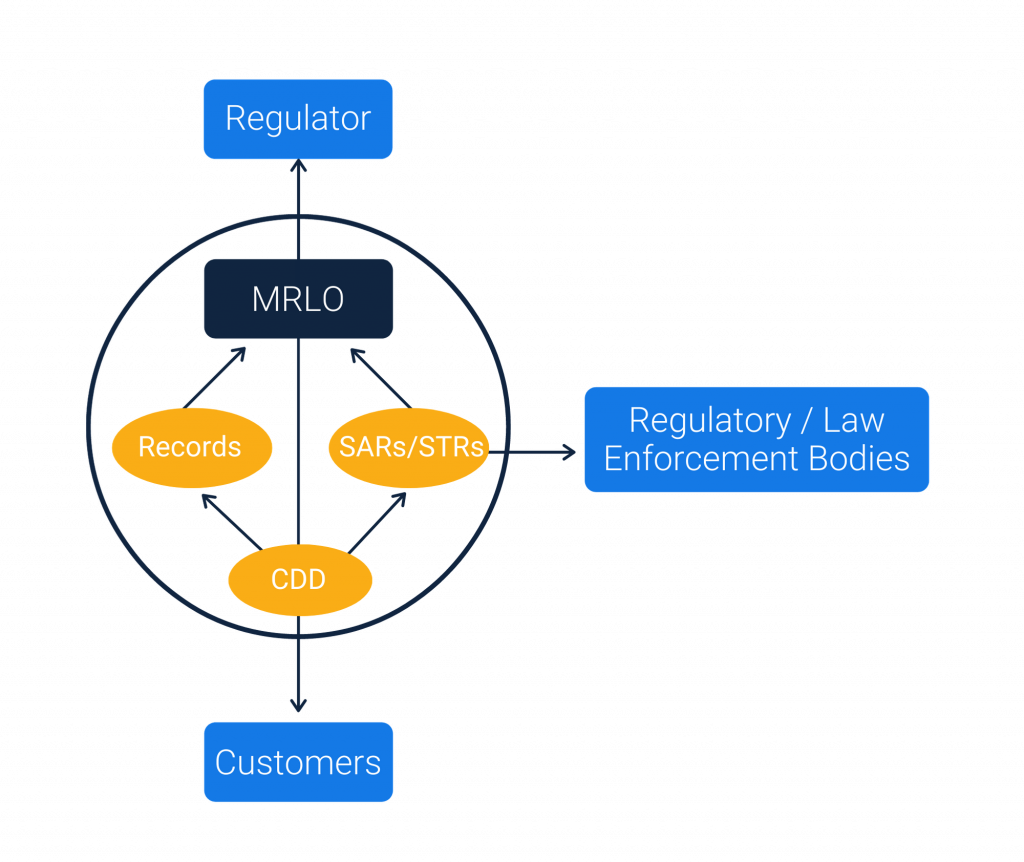
The ecosystem shown above shows the five core responsibilities of Money Transfer Start-Ups:
1. Onboard a Money Laundering Reporting Officer (MLRO)
First and foremost, all start-ups must have a dedicated Money Laundering Reporting Officer (MLRO) who is responsible for managing all compliance activities within the organisation. Depending upon the type and size of the business, there could be one or more members within the compliance team.
Aside from the MLRO, it is important that other stakeholders such as Directors, Senior Managers and even Shareholders familiarise themselves with the Payment Services and AML regulations within the jurisdiction where the business is registered.
2. Customer Due Diligence (CDD)
Each entity is responsible to identify the customers that they deal with. This step is known as the Know Your Customer (KYC). The MLRO has to identify the checks and controls that need to be in place to capture all the information needed from the customers as part of the KYC process.
Apart from KYC, the entity must also maintain the Customer Due Diligence which is mainly to do with checking the customers registering against the watch lists and the transaction patterns of the customers.
3. Suspicious Activity Reporting (SAR)
The entity is required to conduct appropriate investigations whenever an event such as a transaction monitoring alert or a sanctions match occurs. The MLRO has to validate such investigations further and need to report to the local regulatory bodies in the form of Suspicious Activity Reporting (SAR) or Suspicious Transaction Reporting (STR).
4. Record Keeping
The entity is responsible to maintain records of all their customers and transactions for a minimum period of 5 years or as per the guidelines of the local regulatory bodies. The MLRO has to ensure that the data captured from customers for identification and transaction purposes are stored securely and accessible to the authorized individuals of the entity whenever needed. Apart from customers and transactions data, the entity should also maintain the records of all the SARs/STRs.
5. Registering and Reporting to Regulators
The entity is responsible to have the registration done with the relevant regulatory bodies in the jurisdiction where the entity operates from. The entity should also be aware of all the reporting obligations in order to submit reports related to the customers or transactions data to the relevant regulatory bodies in the jurisdiction.
Whether you are a start-up or an established Money Service Business, it is very important that the AML policies and procedures are clearly incorporated within your business model. For more information, advice and support, please contact us.
RemitONE provides proven compliance products for Money Service Businesses and Central Banks and would be delighted to help your business. Contact marketing@remitone.com or call +44 (0) 208 099 5795.
Mobile Money in Africa
Africa is something of an anomaly in the developing world. It’s a continent that many people forget is not a single country but 55 individual countries with dozens of currencies. It’s also a continent where around 66% of the adult population remain unbanked. However, while more than half of the continent has no access to a bank account, the mobile economy is booming. Indeed, Sub-Saharan Africa is the world’s fastest-growing mobile phone market. For the remittance sector, this poses a pretty enticing opportunity.
While the typical customer living out in rural Kenya might live several days away from the nearest bank, they are likely to have direct access to a mobile phone that can be used to send and receive digital payments. This is why the mobile money systems in the region have spread so fast. But how will MTOs cope with increasing digitisation and compliance issues as more customers go online and start using mobile apps to send their money?
To dive deeper into the current mobile money climate in Africa, RemitONE Associate Sales Director Oussama Kseibati recently hosted a webinar attended by esteemed panelists with expert knowledge of the regional remittance landscape. Muhammad M. Jagana, CEO of Kuringo, Sidharth Gautam, Head of Sales at AZA Finance, Leon Issacs, Managing Director of DMA Global, and Linus Adaba, Head of Group Remittance Distribution at Ecobank lent us their thoughts and feelings on compliance and mobile money in Africa in the wake of the COVID-19 pandemic.
Muhammad M. Jagana
In larger cities and towns, there really is no issue when it comes to mobile adoption. Where we’ll face significant challenges is in the last mile of the inclusion journey; the towns or villages that are maybe 200 miles away from a major city.
How do you onboard these clients so they can use mobile money in their local shops and businesses and how will a small local shopkeeper take that payment and convert it into cash to pay their supplier? It’s one of those situations where unless everybody goes digital at the same time, there’s always going to be those at the bottom of the ladder missing out.
For these people, some of whom might not even be aware of the benefits of mobile money, it’s going to be a case of not only education but ensuring that regulators can make it easier for them. For example, in the Gambia, we have two mobile money operators and those two operators are incompatible with one another because they are direct competitors.
Rather than trying to shoehorn everyone onto the same network, we need to ensure there are regulations in place that allow for integration between different networks. It’s up to the regulators to figure out the logistics, of course, but the banks and agents need to play their part too. Something akin to the PSD2 regulations would make the most sense but realistically that’s a rather large hill to climb.
Sidharth Gautam
I completely believe that digitisation and mobile adoption is the key going forward in Africa. At the moment, cash is still king but there is a sea change on the horizon. There are hordes of challenges standing in the way of this change, of course. There are liquidity issues even on the cash pickup front, particularly in Western Africa, as well as the KYC process to sort out, user interface and customer satisfaction. It all comes into play.
There are a lot of plates that need to keep spinning, so to speak. And the regulator has to be on top of it all; the engine leading the train. It’s not an easy task to bring the offline to online puzzle together but it’s not insurmountable either.
Linus Adaba
Personally, I’ve always enjoyed working things into silos and that’s partly how I see mobile money adoption in remittance filtering through into the African market. I see one silo of mobile money that is state-led and the other that’s more private or enterprise led and we are seeing so much more innovation on the private enterprise side because of the lack of regulation.
In order for the state-led operators to catch up, they need to start investing in better compliance tools and putting good compliance managers in place. This way they can ensure people who are using mobile money are at the level of KYC that regulators expect.
When we’re talking about the last mile of the inclusion journey, as Muhammad mentioned, telecommunications companies are selling SIM cards even in the most remote villages, so the infrastructure is definitely there. The problem is that they need to subject themselves to the central bank in each country and there is a lot of technology that’s allowing nimble KYC to be done.
For remittance businesses, meanwhile, there needs to be something of a threshold. Because if it’s just remittance across borders, the full KYC protocol is simply not necessary. In this case, there could perhaps be some sort of a ‘KYC light’ solution. I also see a strong headwind in countries where you have a national ID system in place and we’re currently looking at ways to link this ID with SIM cards to help with faster and better KYC.
Oussama Kseibati
To lead on from Linus mentioning SIM cards and national ID. I think it would be hugely beneficial for the African mobile money market if there was a database such as PSD2 in Europe. With this database in place, once you’ve reached a certain compliance standard with your systems and technologies and you’re ticking the right boxes, doors can open for you automatically.
If there was a centralised database working across countries all linked to SIM cards, you’d be able to use that to do KYC. But what would need to happen first is for a standard to be implemented that will make it easier and more open for people to trade with each other. And that probably isn’t going to happen anytime soon.
For now, instant payments with instant delivery is the way forward for the region I feel. M-Pesa is a positive sign of things to come. It was a major success for Africa throughout the pandemic and the adoption of mobile wallets is continuing to rise in general. Indeed, digitally ready players have seen business growth through the roof as people are migrating towards mobile payments to remain safe from the virus. However, there has to be action in terms of regulation and regulatory frameworks.
Reaching the Great Unbanked
Everything is moving towards the digital market and many unbanked customers are using mobile platforms. That large influx and the onboarding that needs to be done is going to require a lot of compliance and a lot of work but it’s almost certainly going to result in faster, better and more affordable remittance for Africa. Given the fact that remittance rates are so high in the continent right now thanks to a heavy reliance on cash payouts and physical infrastructure, that can only be a good thing.
To read more on what our panellists had to say regarding the more specific challenges facing mobile adoption in the region, click here for our companion piece or check out the full webinar here. If you are a money service business interested in expanding into the region, meanwhile, RemitONE is an award-winning provider of MSB technology.
If you need support with all your operational needs please contact us by emailing marketing@remitone.com to see how we can support you.
