Innovation in Payments and Remittances (IPR) Awards 2023
RemitONE is delighted to announce the winners of the 2023 Innovation in Payments and Remittances (IPR) Awards.
Start-up of the Year Award 2023
Winner: PayOnlime
Honourable mention: Lollicash
Scale-up of the Year Award 2023
Winner: Clear Junction
Honourable mention: Remit Choice Limited
Leader of the Year Award 2023
Winner: Jones Amegbor, Founder & CEO (PayAngel)
Excellent Customer Service Award 2023
Winner: Trust Payments & Unity Link
Innovation Award 2023
Winner: Currencycloud
Social Impact Award 2023
Winner: HelloPaisa
Honourable mention: PayAngel
All entries were thoroughly evaluated by our esteemed judges comprised of global senior experts in the payments and remittance industry:
- Leon Isaacs, CEO & Founder, DMA Global
- Kathryn Tomasofsky, Executive Director, MSBA
- Lindsay Lehr, Managing Director, PCMI
- Rob Ayers, CEO, Fintech-Advisors
- Sharon Gibson, CEO, JMMB Money Transfer
- Veronica Studsgaard, Founder & Chairman, IAMTN
After the initial assessment, the award finalists were unveiled in August 2023. This was followed by the second stage, during which the judging panel reviewed all the finalist entries and selected the winners in each category through an anonymous scoring method.
The award winners were announced at the IPR Awards ceremony during the IPR Global Hybrid 2-day event on Tuesday 26th September, in London, UK.
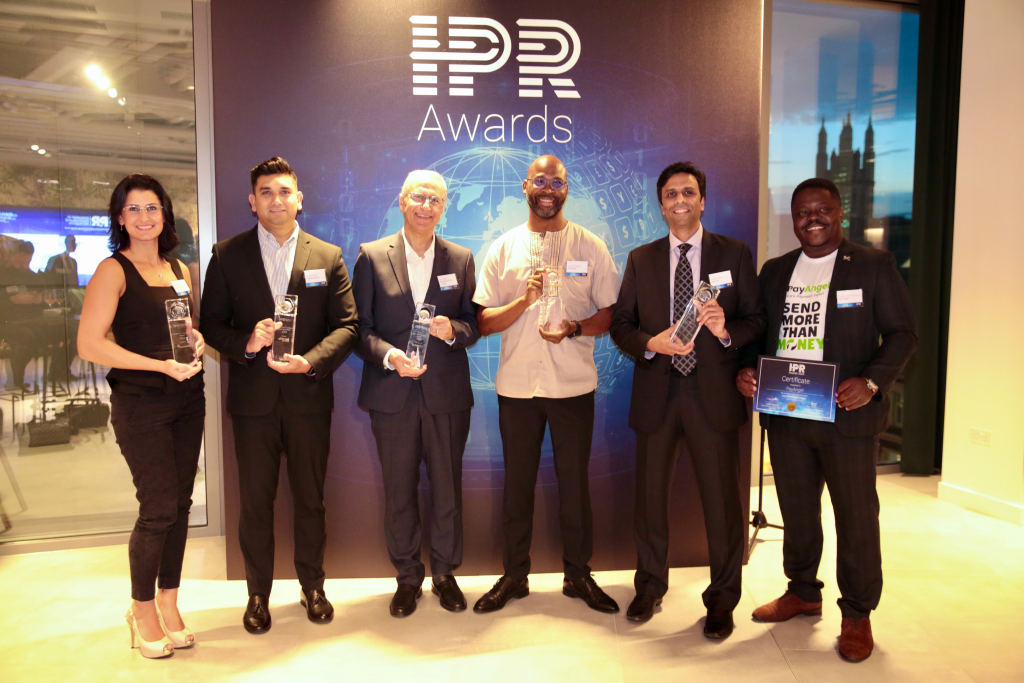



From Left to right pictured: (Top left) Larissa Rocha, Wayne Gould, Adel Taher, Jones Amegbor, Sohail Nizami and Joseph Lamptey. (Bottom left) George Boateng and Lindsay Lehr. (Top right) Rob Ayers and Adel Taher. (Bottom right) Sohail Nizami and Leon Isaacs.
About Innovation in Payments and Remittances (IPR)
In 2018, RemitONE launched Innovation in Payments and Remittances (IPR) to bring together various industry supply chain members to drive positive change. Through events and research reports, IPR brings together senior business leaders dedicated to enhancing the industry, enabling them to think big, share best practices, engage, learn, discover, create opportunities and shape change. With the power of collective insight, we can push innovation and industry growth boundaries and benefit from better outcomes.
The first IPR event was held in the iconic London landmark, The Shard. In 2021, due to the pandemic, the event was hosted online and attracted over 3,000 registrations worldwide. The IPR events are organised throughout the year to help industry stakeholders, visionaries and business leaders make informed decisions that ultimately benefit the consumer.
About RemitONE
RemitONE is the leading provider of end-to-end money transfer solutions for banks, money transfer operators (MTOs) and fintech start-ups worldwide. Our award-winning money transfer, compliance software products and consulting services – including MSB licensing, bank account provisioning and connections to our clients and partners – are tailored for the global money transfer market.
Organisations of all sizes use our platforms to run their remittance operations with ease and efficiency by reaching out to their customers via multiple channels, including agent, online and mobile.
For more information, or to access all the photos from the IPR Awards ceremony, please contact marketing@remitone.com
RemitONE Winners of the Remtech Innovation Remittance Solution Award at GFRID | United Nations Summit in Kenya, Africa!
We are delighted to announce that RemitONE has secured the prestigious Innovation Remittance Solution Award at the RemTECH Awards 2023 – GFRID | United Nations Summit in Kenya. This incredible achievement underscores our commitment to revolutionising the payments and remittance industry through cutting-edge solutions.
The RemTECH Awards, organised by CrossTech and held as part of the GFRID | United Nations Summit in Kenya, served as a platform to honour remarkable achievements and advancements in the fintech industry. Over three days, industry professionals from around the globe congregated to celebrate and engage in an enlightening conference.
Our success in the Innovation Remittance Solution category can be attributed to the groundbreaking tools we have developed. Notably, our Multi-Online Remittance Manager™ and Multi-Mobile Remittance Manager™ have played a pivotal role in advancing financial inclusion. These game-changing solutions bridge the gap between the banked and unbanked populations, providing greater accessibility and convenience for money transfers through our digital innovations.
We had the privilege of being assessed by esteemed judges who acknowledged the significance of our innovation. Leon Isaacs, judge and CEO of DMA Global, presented us with the award and praised our approach. He emphasised, “RemitONE has seen a problem and looked at various solutions and put them together in a way that truly works for the people who use their services or could utilise their services, which I think is innovative in many ways.”
Representing RemitONE at the event, our Managing Director of Africa, Ababacar Seck, accepted the award and delivered an inspiring acceptance speech. He reiterated our commitment to empowering clients, including banks, money transfer operators (MTOs), startups, and central banks, with innovative solutions tailored to their specific needs.
This award serves as a testament to our relentless pursuit of innovation and excellence. At RemitONE, we remain dedicated to shaping the future of the payments and remittance industry and improving the lives of migrants and their families worldwide.
To learn more about our award-winning Money Transfer Software reach out to us at sales@remitone.com.
The Silicon Valley Bank Collapse: Challenges and Opportunities in the Money Transfer Industry?
Silicon Valley (SVB) was the go-to bank for many tech startups and its recent fall has left a sense of uncertainty within the community, with many wondering if this will impact their own banks. In this article we’ll focus on the aftermath of SVB’s collapse, exploring what it means for the industry and the opportunities it offers for innovation and advancement in the payments and remittance spaces.
First, let’s backtrack to how this happened in the first place, and explore the warning signs. The foreshadowing of SVB’s downfall began with their investment in treasury bonds which later hit them with a major blow as interest rates spiked up in an attempt to slow down inflation. The unprecedentedly sharp increase in withdrawals outnumbered their deposits as venture capitalists were investing less in startups whilst customers were withdrawing their funds at an accelerated pace. This made matters worse for SVB, as they had to provide the funds to compensate for the loss, and in desperation, they sold their bonds at a much lesser value, resulting in a huge loss of $1.8 bn.
What effect has this had on the money transfer industry?
Challenge #1: Slower Operations and Increased Costs
SVB’s collapse caused considerable hindrances for payroll, resulting in delayed or unpaid payments to employees. This also may have led to a shortage of staff and disruptions to money transfer companies’ day-to-day operations, leaving businesses understaffed and unable to resolve customer issues or complaints.
As a result of these setbacks, customers may have experienced missed or delayed transfers, which must have had a serious impact on the customer’s trust and confidence in the money transfer market. Businesses may have suffered from a decline in transaction volumes and revenue slowdowns as a result.
Solution #1: Rebuild Customer Relationship
Money Transfer Operators (MTOs) must win back customer trust. They can achieve this by investing in a secure and scalable technology platform that is built on a robust infrastructure. Additionally, offering a range of services beyond simply money transfers (e.g. utility bill payments, wallet transfers, airtime etc), can also help gain customer trust.
MTOs can also strive to offer even more competitive rates and lower transaction fees, which not only attracts new customers but helps retain trust with existing ones. Cost reduction can happen by investing in technology that automates processes and compliance procedures and opens up new revenue-sourcing channels such as mobile apps and online portals.
Challenge #2: Difficulty for Immigrant Communities
The remittance market thrives hugely on transactions by immigrants who send money to their home countries.
With the exit of some smaller players, larger companies can gain more bargaining power to increase the costs of fees and charges; this burden is then passed onto the end customers, making it more difficult for the latter to send money to their loved ones.
Solution #2: This problem may, in fact, prompt a change in customer behaviour. For example, challenging circumstances can often push people to explore alternate routes which they may have been hesitant to use before, such as mobile money. This may result in traditional banks losing some of their dominance over digital banks, allowing the latter to gain market share, especially as they often have lower fees and are more convenient.
In addition, digital banks are continuing to gain ground in the money transfer market; this may likely continue as more people become tech-savvy and embrace its benefits. It is crucial for MTOs and digital banks to evolve and adapt to meet customers’ changing needs by monitoring the market and consistently updating their marketing strategy.
Challenge # 3: Tighter Regulation
The Federal Reserve introduced a new program to help tackle instability and safeguard companies impacted by SVB’s downfall. Similarly, this could inspire money transfer regulators to also introduce tighter rules and regulations around monitoring and tracking transactions using reliable technology platforms.
However, there are some downsides as well, including a slowdown in operations and higher costs. A rise in compliance expenses may also result in companies having to exert more money to invest in new technology or additional staff to comply with regulations. This is especially challenging for smaller companies that may not have sufficient funds. It can also lead to increased delays in transactions as agents and companies need to perform additional checks.
Solution #3: Despite these challenges, this could in fact improve compliance practices in many companies. With reliable technology platforms to enforce transactional monitoring and process automation in place, companies can reduce the risk of fraud and improve their security measures. All of these improvements will aid in strengthening the money transfer industry and allow it to become more reliable than ever.
The Outcome for the Industry: Innovation Opportunity
Despite the challenges brought about by the recent instability in the payments and money transfer industries, this situation can also stimulate growth opportunities.
As areas of weakness within businesses are revealed, a better understanding of how to improve processes and systems will also become apparent. In addition, the retreat of some tech companies will provide opportunities for new players to enter with fresh ideas, products and services. Simultaneously, it encourages industry players to collaborate in finding solutions as each can provide their area of expertise to resolve the problem, creating beneficial progress.
RemitONE and other tech providers can help companies affected by the SVB collapse.
Don’t miss out on industry insights – join our community of professionals and be the first to hear about trending topics, exciting events and more!
Contact marketing@remitone.com to find out more.
Video: Saving the Crucial Role of Agents and Banks in the Remittance Industry
Brought to you by RemitONE, the Innovation in Payments and Remittances (IPR) Global Hybrid event took place on 19-20 October 2022 and included a series of fantastic discussions.
Wallets have been on the rise in recent years which has forced banks to embrace technological advancements to keep up with the pace of digital innovations in the remittance industry. In this panel, we uncover the driving forces behind this change and the possible impact it may have on banks, agents, and the overall money transfer landscape in the coming years.
Moderator:
- Ababacar Seck, Managing Director – Africa, RemitONE
Our panellists include:
- Sharon Gibson, CEO, JMMB Money Transfer
- Leon Isaacs, Founder and CEO, DMA Global
- George Boateng, COO, Unity Link
Why are pay-out transactions shifting to wallets?
There’s been an increase in the popularity of pay-out transactions through wallets, due to their accessibility and simplicity. This upward trend is particularly prominent in Asia and Africa. For example, in Ghana, the mobile money market reached $121.8 Billion in 2022 and is expected to grow to $590.7 Billion by 2028. George believes the reason behind this is attributed to factors such as convenience, as wallets are more easily within reach than banks, and overall save time and effort.
Leon also reinforces, wallets are often preferable as they’re easy to use which means people don’t require additional assistance. Other drivers are, the senders have more options, people have become more digitally savvy and most notably, it’s cheaper. Another key benefit of wallets is their increased security due to tokenization, which is a unique identification number attached to any personal information such as account numbers.
However, it’s not the same in every region. Sharon shares that in Jamaica there’s only one institute that offers mobile wallets, but that could change very soon. The recent launch of CBDC can possibly encourage more institutions to embrace digital wallets.
How can banks and traditional agents cope in the digital era?
Leon states in many cases it’s rare for agents or banks to be solely a remittance business. While they may have their core purpose, they should adapt and diversify their services to progress ahead in the competitive market. Sharon suggests that banks can collaborate with more agents to offer their products and services and satisfy client needs, however, there need to be adequate technology capabilities in place for it to be a success.
Data shows that customers prefer the physical contact of agents as they instil trust and provide clear guidance when a problem occurs, as opposed to communicating with a bot. A study even found that 64% of customers commented that they could not solve a problem when using mobile apps to transfer money. Overall, agents play a crucial role in building customer trust and loyalty especially as a large proportion of transactions are still carried out in stores and not through digital means, which proves they still hold a strong position.
There are different considerations for the send and receiving end for agents. The pandemic did accelerate a surge in people adopting digital payments and transactions which resulted in a lesser need for people to visit agents, and it’s likely that this will continue. As for the pay-out side, there is potential for agents to educate customers as online accessibility varies in countries where people are still hesitant about online banking and money transfers – this creates a good chance for agents to bridge the gap by acting as the intermediaries between clients and digital payments. Customers already trust these agents, which makes it more probable for them to adopt changes with the agents’ help.
Leveraging technology is another technique agents can utilise to enhance efficiency and strengthen their role further. For instance, many people have formed personal relationships with agents but sometimes lack financial literacy. In such cases, agents can take advantage of innovations such as card readers to increase customer security and reinforce the trust clients have in them. This can solidify the bond between the agent and client as well.
MNOs are taking over transactions led by banks, is this healthy? What does this mean for the future of final inclusion?
There is no denying that competition drives innovation and MNOs gaining the lead has pressured banks to also step up their game to progress ahead. MNOs often educate the underbanked on how to use their products, an area where banks are lacking. There’s also greater flexibility with MNOs, as people can instantly access their digital funds from the comfort of their homes without the need for documentation and physical visits to the bank, helping them to save precious time.
MNOs particularly boast a good distribution of agents across both send and pay-out. However, their products excel in locations where there is a vast digital presence (although they still have a huge potential to increase penetration of financial services, which will continue to encourage financial inclusion). In locations where there is good digital infrastructure, the need for agents to pay out cash is also lessened, this creates a window of opportunity for them to diversify their products and services. One example is M-pesa in Africa, where digital wallets are the primary method of payment. As a result, customers rarely use physical cash, which suggests that people will only need to visit a branch for a specific need unrelated to money transfers or cash-outs.
The changing face of remittance clients requires a new approach, how can MTOs keep on top of the needs of clients and how will this affect the business model?
In contrast to the past, migrants are more skilled individuals and therefore less reliant on agents, demonstrating increased digital literacy. As a result, the power balance has shifted to the customers, with the internet providing easy access for them to quickly switch to other companies if they are unsatisfied with the service.
Clients also tend to focus more on convenience, such as banking being available everywhere at any time and more demand for receiving immediate results. This places a heavy burden on banks – they often have to increase their costs to expand their workforce and enhance their operations more robustly. However, with the increasing popularity of social media, email, live chat and phone, it becomes challenging for the banks to meet the demand – this can lead to dissatisfaction, complaints and negative reviews, overall damaging the brand’s reputation.
To minimise this problem, Sharon proposes a collaborative relationship between banks and agents, to exchange knowledge and expertise and gain a thorough understanding of the client’s needs. Leon explains that companies need to rethink their strategies to maintain a close connection with clients whilst keeping pace with their changing needs. However, a positive takeaway is that customers are benefiting from having their needs finally met and the industry continues to thrive.
Can technology help agents preserve their role?
Whilst technology can be costly, it can be a useful tool to streamline operations more effectively. One way is gathering accurate data in a more interactive way instead of relying on traditional surveys. Social media platforms like Twitter polls can help analyse consumer behaviour, identifying factors which motivate them to pick specific agents over others.
As the rapid surge of digitalisation continues, more businesses are having to adapt. At RemitONE, we play a pivotal role in helping banks shift to the online realm. Our software empowers agents to provide customers with user-friendly portals whilst providing an array of options for them to choose from, such as airtime top-ups, prepaid card services and more. By utilising our industry-leading software, you can increase your transaction rates whilst maintaining top-notch security through our AML and KYC checks. This results in a seamless process from send to pay-out. You can also gain access to our global network of clients and partners that we have built over decades for you to access right away, saving you time, cost and headache.
Interested in powering up your business? Get in touch with our experts to provide your customers with a secure, convenient, and exceptional money-transfer experience.
Tap into our experts and schedule a free consultation.
References
https://www.imarcgroup.com/ghana-mobile-money-market
https://www.westernunion.com/blog/en/leery-of-how-digital-wallets-work-let-us-break-it-down-for-you/
