Ep 14: The Remittance Customer Has Changed. Have Providers? November 28, 2026
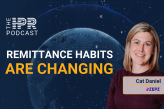
Customers are sending smaller amounts more often, supporting multiple people across borders and expecting the same ease and convenience they experience from the digital services they use every day.
In Episode 14 of the IPR Podcast, Natalie Perkins, Marketing Manager at RemitONE, speaks with Cat Daniel, VP of Growth and Marketing at Zepz, the group behind WorldRemit and Sendwave. Drawing on insights from more than 5.5 million senders, they explore what these changes mean for the future of money transfers.
1. Why customers are sending smaller amounts more frequently
Remittances are increasingly supporting everyday expenses, making regular, smaller transfers an important part of how people support family and friends across borders.
2. Why sending money to multiple people needs to be easier
More than 70% of Zepz’s customers send money to multiple people, highlighting the need for simpler ways to manage receivers and repeat transfers.
3. What digital-native customers expect from remittance apps
Younger customers expect the same speed, simplicity and familiar user experiences they get from apps such as Uber and DoorDash.
4. How providers can build stronger customer loyalty
Reliability, convenience and rewards that reflect different customer needs can help providers give customers more reasons to stay.
5. How wallets and stablecoins could give customers more flexibility
Digital wallets and stablecoins can help customers hold funds, save towards larger expenses and choose when to send or access their money.
Want to turn your app into an everyday payments app?
Discover which services your customers wantYou’ll also receive a tailored revenue estimate report, based on your business’s transaction volumes and the services that best fit your customers.
Questions about changing remittance customer behaviour
How is remittance customer behaviour changing?
Remittance customers are increasingly making smaller, more frequent transfers to support everyday expenses. They are also sending money to multiple people rather than just one receiver. Zepz’s research, drawing on insights from more than 5.5 million senders, highlights how cross-border money transfers are becoming part of customers’ everyday financial lives.
How many remittance customers send money to multiple people?
More than 70% of Zepz’s customer base sends money to more than one person, according to Cat Daniel. This highlights the importance of making it easy for customers to manage multiple receivers, save their details and send money without repeatedly entering the same information.
Why are smaller, more frequent remittance transfers becoming more common?
Customers are increasingly using remittances to support everyday activities, such as buying groceries or paying for smaller purchases. Cat Daniel explains that people are living their cross-border financial lives in much the same way as their in-country financial lives. This means sending money can become a more regular activity rather than something reserved for larger expenses.
What do younger remittance customers expect from money transfer apps?
Younger, digitally native customers expect remittance apps to offer the speed, simplicity and convenience they experience with other digital services. This includes familiar navigation, intuitive touch and swipe commands, stable platforms and straightforward payment journeys. Cat Daniel points to apps such as Uber and DoorDash as examples of the experiences shaping these expectations.
How can money transfer operators build customer loyalty in 2027?
Providers can build loyalty through reliable services, fast transfers, easy-to-use apps and experiences that make customers feel recognised. Cat Daniel also recommends understanding what different customer groups value when it comes to rewards. These could include fee-free transfers, better rates, cashback or supplementary services such as eSIMs and entertainment subscriptions.
How can digital wallets and stablecoins benefit remittance customers changing needs?
Digital wallets and stablecoins can give customers more flexibility over how and when they hold and move money. They can support holding balances, saving in smaller increments and choosing when to send funds or make payments. Cat Daniel explains that these technologies should be designed around what customers want to achieve, rather than promoted as an end in themselves.
Should remittance providers compete on transfer fees alone?
No. Cat Daniel argues that a purely transactional, cost-based approach does not reflect how customers increasingly use remittance services. Providers should also consider the wider customer experience, including convenience, multiple receivers, digital wallets, savings options and services that support customers’ cross-border financial lives.
Episode transcript
Show or hide the full transcript
Host: Natalie Perkins, Marketing Manager, RemitONE
Guest: Cat Daniel, VP of Growth and Marketing, Zepz
Edited for clarity. Timestamps refer to the supplied recording.
What does Zepz’s research reveal about changing remittance customers?
Natalie Perkins [00:43]: Hi everyone and welcome to the IPR Podcast. I’m Natalie Perkins from RemitONE. Joining me today is Cat Daniel, Vice President of Growth and Marketing at Zepz, the group behind WorldRemit and Sendwave.
Today we’ll explore what the data tells us about the modern remittance customer and how MTOs should respond. Cat, thank you so much for joining me on the podcast today.
Cat Daniel [01:05]: Thank you.
Natalie Perkins [01:06]: Let’s start with the thinking behind the reports. Why did Zepz focus on the people behind the transfers, rather than corridor growth and transaction values?
Cat Daniel [01:17]: For us, the customer is always the most important thing because you need to build the remittance landscape around customer use cases.
We also have five and a half million customers who we can collect that level of insight from, so it felt really relevant for us to do that.
The customer is always at the heart of everything that we do. Within our business, we regularly listen to conversations with customers. We look at their changing patterns and how we develop our product roadmap in response.
It felt sensible to focus on the people, their needs and their attitudes, rather than just the numbers, and understand how those are developing.
Natalie Perkins [02:05]: You’re in a unique position to do that with the number of customers you have.
Cat Daniel [02:10]: Definitely.
Why are more remittance customers sending money to multiple people?
Natalie Perkins [02:11]: Which finding most challenged the traditional picture of a remittance sender, and what do you think the industry should take from that?
Cat Daniel [02:19]: One of the most interesting things for us was the evolution of one-to-many relationships.
Senders are no longer sending to just one person. Over 70% of our customer base sends money to more than one person.
From an industry perspective, it’s interesting to think about how you can allow senders to hold balances and then send money to multiple people in a really simple, easy way.
The user experience needs to change as well, so customers can send to multiple people really simply rather than having to load receiver details every single time.
Integrations that make it easier to get people’s details into the app are also important. It can be very labour-intensive if every time you choose to send, you have to input details in a cumbersome way.
Natalie Perkins [03:19]: Definitely. Let’s now look at how remittances fit into the everyday life of the customer. Many transfers in the report are small and frequent. What do you think that tells us about the role remittances play in everyday life?
Why are remittance transfers becoming smaller and more frequent?
Cat Daniel [03:37]: I think it’s really interesting. It’s easy to make the assumption that people are sending big amounts for big things, but I actually don’t think that’s the case.
Our research and recent customer research show that people are living their cross-border financial lives in the same way as they live their in-country financial lives.
People might send $10 to a family member to purchase a cinema ticket, in the same way they would if they were having that conversation in person.
That’s an interesting shift from things like paying for school fees or groceries on a less regular basis. Transfers are becoming much more transactional and regular, but involve smaller amounts.
Natalie Perkins [04:27]: It’s much more like how you would act if your children were in the same house as you. You might give them some money to go to the cinema, and that’s how people are acting digitally across borders.
Cat Daniel [04:40]: Exactly. I think this behaviour is also changing when you’re in the same house and the same country as someone.
Monetary transactions are becoming much more digitalised, and that is transferring to the global economy too.
Some of that is to do with the sender landscape starting to skew towards a younger audience. They are absolutely a digitally native audience who can make transfers really quickly and easily in everyday life.
They almost expect that level of convenience across borders in the same way they experience it normally.
How should money transfer operators respond to younger and female senders?
Natalie Perkins [05:24]: You’ve mentioned that younger people are now the largest sender group. There was also a point about women accounting for close to half of all transactions. How should this influence the way MTOs design and market their services?
Cat Daniel [05:41]: When you’re operating in such a digitally native population, you really need to think about the user experience, usability, commands and the way people navigate through the app.
The usual things are all relevant: a stable network, speed, simplicity, ease of paying in and ease of payout.
But other things become important too, such as touch commands in the app. You need to consider how people literally navigate through the app.
People who regularly use transport apps such as Uber or food delivery apps such as DoorDash navigate through those apps in a certain way. They expect swipe commands to exist and the next button to be in a particular place.
When you watch customers during user testing, you see them expecting apps to operate in the same way as some of the bigger super apps outside remittances.
That’s something we take into our app, particularly when working with customers who don’t always have the language of the app as their first language.
It’s incredibly important that apps follow a pattern people expect to see. Learning from the apps people use every day is critical because it almost becomes muscle memory to navigate in a certain way.
What makes a good remittance app experience?
Natalie Perkins [07:07]: Beyond attracting customers, what should MTOs do differently to build loyalty as people expect more control, personalisation and flexibility?
Cat Daniel [07:17]: Loyalty is driven by a number of things, just as it is for all brands.
Sometimes you’re willing for something to take longer because you know it will work in the way you want it to. Other times, speed is really important.
Sometimes it’s literally about how a brand makes you feel and how recognised you feel by that particular brand.
Some things are non-negotiable. Speed, stability of the platform and the ability to navigate through an app are really important.
How can remittance providers build customer loyalty through rewards?
Cat Daniel [07:54]: There are also some really nice things we can do to reward customers with more surprise and delight moments.
For example, celebrating when they’ve successfully sent money, or rounding up their activity to show them how much they’ve sent to particular family members. It’s a way to recognise and value the support they’re giving to family and friends globally.
There are also opportunities to reward customer loyalty through specific loyalty programmes.
However, it’s really important to recognise that customers don’t all feel rewarded by the same things. Different customer groups have very different perceptions of rewards and what’s important to them.
Sometimes that might be a fee-free send. Sometimes it might be better rates for a particular send or cashback.
It might even be supplementary products such as eSIMs that support their global lifestyle, sports subscriptions or subscriptions to film and TV networks such as Netflix.
It’s about listening to customers, understanding what they would like and need, understanding how they want to feel recognised and then building those moments into the app.
Natalie Perkins [09:32]: I really love that. Don’t follow a one-size-fits-all approach.
Cat Daniel [09:36]: Exactly.
How can digital wallets and stablecoins support changing remittance needs?
Natalie Perkins [09:37]: Let’s look beyond the transfer itself. How have these changing customer needs influenced products such as the SendWave wallet and Zepz’s use of stablecoins? Do you think customers care about the technology itself, or mainly about what it allows them to do?
Cat Daniel [09:57]: I’m a firm believer in starting with the customer, what they need and what they’re trying to do, and then building the technology to support that.
I really believe that customers want to live a more digitalised cross-border financial life, and it’s our responsibility to build the technology around that to enable it.
Stablecoins are definitely part of that. There are many reasons why a customer might want to use stablecoins, including holding a balance in a wallet and potentially mitigating currency fluctuations.
But I think these are more about enabling people to save or send money at the right time, or allowing the people they’re sending to take the money out at the right time.
It’s not necessarily something you would talk to customers about as if it’s what you want them to do.
What we actually want them to do is live a seamless cross-border financial life, being able to send and move money really easily in whatever way they want.
Stablecoins and wallets where customers can hold a balance are enablers for that, but they aren’t the whole picture.
How can digital wallets give remittance customers more flexibility?
Cat Daniel [11:18]: Wallets allow you to create infrastructure for people to save money. They can potentially invest in a broader portfolio, and wallets also enable the one-to-many sender relationship we discussed.
They allow customers to send money to someone who could hold it in a wallet and then send it to other family members. Those family members could potentially use a borderless card to pay for goods and services, all within the same ecosystem.
Natalie Perkins [11:55]: Could you share a little more about the use case and how it would help with currency volatility?
Cat Daniel [12:04]: If you think about somebody making a payment for school fees, for example, a wallet enables them to do that at whatever moment is right for them.
If someone has an amount of money they know they’re going to put towards that expense, they can hold it in a stablecoin wallet. They don’t need to make the transfer to the person it’s intended for until the point in time they choose.
They can also save in small increments if they’re able to set up a supplementary savings account. That allows them to save gradually towards larger purchases.
It gives customers flexibility, rather than making everything a transactional, immediate activity. It allows them to plan in a much more systematic, longer-term way.
That’s how we’re thinking about building our ecosystem moving forwards. I think everyone should consider how to give consumers as much choice and optionality as possible.
Why should remittance providers look beyond transfer costs?
Natalie Perkins [12:44]: So it’s really moving far beyond just being able to send money in and out of people’s homes and looking at how they can save money too.
Cat Daniel [13:08]: Definitely. The purely transactional, cost-based idea of remittance is definitely not the way that people should and will evolve the landscape.
Even when you think about the more rural corridors, the way the payout network is evolving means that cost can no longer be the only focus.
If that was the only area we focused on, we would definitely lose sight of customer needs.
What should money transfer operators prioritise over the next three years?
Natalie Perkins [13:41]: So Cat, if you’re advising an MTO planning for the next three years, what’s one assumption about remittance customers it should leave behind?
Cat Daniel [13:50]: I would say be really careful of assumptions. Think about specific customers, their needs and the ways they want to live their cross-border financial lives.
The biggest piece of advice I would give is to think about a broader ecosystem, with a range of choices that allow customers to do things seamlessly.
It shouldn’t just be one-to-one remittance behaviour in the old, traditional way.
Giving customers those options allows you to take their different attitudes and needs into consideration and lets them send money in the way they want to.
Natalie Perkins [14:34]: Thank you, Cat. That’s a useful bit of advice to finish on. Thank you for joining me on the podcast.
Cat Daniel [14:38]: Thank you. It’s been a pleasure.
Related Posts
-
Introducing RemitONE Liveness Verification: stronger onboarding, lower costs
Help protect your money transfer business against impersonation and save up to 60% on liveness verification costs.* When…
November 26, 2026 -

Ep 13: Digital Wallets and Remittances: What Happens After the Money Arrives?
One customer receives a money transfer and cashes it out. Another pays a bill from their wallet. What makes…
November 5, 2026 -

EP 12: Money Transfer Operators: Licensing, Stablecoins and AI — What Matters?
Will the licence you’re pursuing help you get the banking relationship you need? Natalie Perkins asks Veronica Studsgaard how…
October 27, 2026 -

Remittance Platform vs Cross-Border Payment Infrastructure: What Does Your Business Actually Need?
When choosing how to manage and deliver cross-border payments, it can be difficult to know whether you need a…
October 14, 2026 -
RemitONE Partners with Prime Remit Transfers Limited to Expand Payout Network in Uganda
Expanding into a new corridor usually means months of negotiating local connections, vetting partners and building integrations. A new…
October 14, 2026 -

Ep 11: Stablecoin Settlement for Remittance Providers: Can It Reduce Prefunding, Costs and Friction?
Could a settlement change reduce the cash you hold in a corridor? Natalie Perkins, Walter D’Cruz and Oussama Kseibati…
September 29, 2026
